There is a battle of two wolves inside us all. The wolf that wins is the one you feed (after a Cherokee proverb).
The human personality, like other aspects of human well-being, arise from both genetic and environmental factors. Experiences from childhood; treatment by parents, siblings, and others; cognitive and emotional activities; degree of fulfillment of basic needs; and genetics all weigh in as our perspectives and beliefs about ourselves and others (our mindsets) lead to responsive behaviors (our behaviors), both of which interact with feelings and emotions. Our personalities are, in some ways, the “face” of who we are in social settings. Our presentation of self in the world has massive consequences: our belonging, status, persuasiveness, self-efficacy, and relationships all depend, in some part, on this presentation.
You likely have a sense already of your personality – the characteristics, preferences, and actions you take in social settings. Think of a time you felt like you were being yourself and getting lots of positive vibes around the project, problem, or people you were trying to interact with. Felt good, didn’t it? Now ask yourself if you were acting authentically or just to get some validation. If the former, you were acting out of your true self. In those moments, your characteristics were innate, what Jim Collins calls “encodings.” These are the deepest alignments with your true self and when we are “in frame” (Collins) or “in flow” (Csíkszentmihályi) things come easily and freely. When there are mismatches between how we want to be and what others expect from us, we can expect to feel anxious, worried, and on alert, and we adjust, sometimes in maladaptive ways, like pretending, people-pleasing, hiding, or lying. We operate best – with ourselves and others – when we are closest to our true self operating in flow.
Coaching is a great opportunity to explore these encodings and contexts that lend themselves to finding flow. None of this is a secret: an entire industry has arisen to help folks identify their own personal personalities and how that personality interfaces with others in team or organizational contexts. For the coach, these tools can be really helpful, but they also complicate. To illustrate, I’ll summarize four inventories I have personally found useful and/or have used with teams: Myers-Briggs, DISC, Gallup Strengths Finders, and the Enneagram. All of these operate on self-assessments: a topic we will return to.
Myers-Briggs (MBTI):
The MTBI is likely the most well-known of these inventories and identifies preferences along four continuaa resulting in sixteen possible MBTI personality types: Intro- or Extroversion (I or E), Intuition (N) or Sensing (S), Feeling (F) or Thinking (T), Judging (J) or Perceiving (P). Each of these spectra measure, respectively, how one gets energy (E/I), how one learns (N/S), approaches to decision making (F/T), and approach to organizing one’s environment (J/P). The idea is that a person exhibits dominant traits resulting in a composite. I have taken the MBTI myself many times with fairly stable result (ENFP) until a few years ago after a personal crisis in which I switched to (INFP). Interestingly, the preference for the the “I” is quite weak. The MBTI has conceptualizes folks in the middle of a spectrum as being “ambidextrous” and able to code shift.
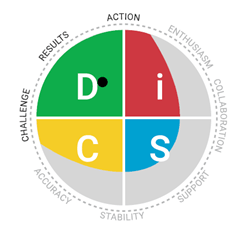
The DISC approaches personalities in a similar way around Decisiveness and Results (Dominance), Relationships and Inclusivity (Influence), Harmony and Supportiveness (Steadiness), and Quality and Ethics (Conscientiousness). DISC focuses on preferred behaviors, such as communication styles.
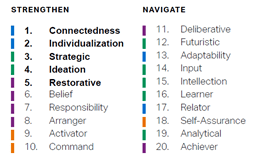
Strengths Finder assesses individual talents and strengths, providing a “DNA composite” of positive traits.
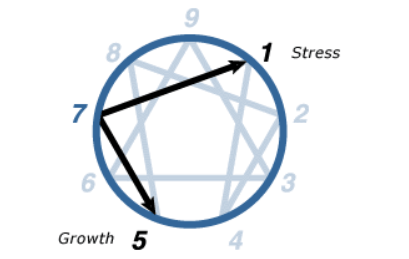
The Enneagram is a personality inventory that is predicated on the idea that we have a we “are born with a dominant type….an inborn temperament and other pre-natal factors being the main determinants of our type.” According to the Enneagram, we adapt this personality type to early childhood experiences and carry the result forward into our daily practices and relationships. Nine types result and provide a foundation to better understand attitudes, behaviors, beliefs, and orientations. Notably, the Enneagram has a feature that others do not: the dominant personality is also tied to “health levels” and a defined cascade of development (or regression) as health levels vacillate between levels that are healthy and growth oriented or stressed and compensating. The Enneagram both predicts behaviors and informs development. In the example below, the “Enthusiast” Type 7 who is enthusiastic, curious, and engaged when healthy can grow toward an “Investigator” Type 5 with focus, creativity, and insight. They can also deteriorate under stress to an unhealthy “Reformer” Type 1 who can be impulsive, addictive, trying to change themselves and even succumbing to self-destructive tendencies.
There are other personality profiles out there but these four provide an overview of approaches and possibilities for informing coaching and self-improvement.
But do they reflect meaningful approaches and possibility or are they just a means to organize people into groups? Adam Grant, author of Think Again, has famously criticized the MBTI and his points resonates across all of these inventories. All of these inventories are based upon self-reflection which raises a key question: how can any of us, especially when we are not healthy, see ourselves with reality? Furthermore, are they based on science or are they essentially just made up?
Uses in Individual Coaching:
As it turns out, most of these models are not scientifically validated, but they may still be useful due to an emerging recognition that is: our personalities like our brains are plastic. We can change not only our beliefs, but because we can change our beliefs, we can also modify at least aspects of our personalities. This is known as volitional personality change, and its based in cognitive behavioral therapy (CBT).
Here’s how it might work. Hebb’s Theory states that neurons that fire together wire together. Internal self-talk or experiences create feelings or emotional response that we act upon in various ways. When reinforced, associations develop and the mind begins to predict responses that last longer, thus feelings become moods, self-talk becomes belief, and actions becomes habits. As the time horizon lengthens, our moodiness persists and, eventually fixes, in the form of a personality trait.
But what if we change our self-talk, providing affirmations where we once engaged in self-chastisement? What if we change our experiences and our actions, and develop new habits. As we alter our health levels, we begin to rearrange beliefs and behaviors. As we rearrange, we rewire, we refire: we change.
Coaching is a chance to accelerate that rewiring with focus, intention, accountability, and effort. A coach walks beside the client helping them realize the goals they set for themselves.
Which wolf are you going to feed?
Collins, Jim. What to Make of a Life: Cliffs, Fog, Fire and the Self-Knowledge Imperative. HarperCollins, 2026
Csikszentmihalyi, M. (1991). Flow: The Psychology of Optimal Experience: Steps toward Enhancing the Quality of Life. New York: Harper Collins Publishers.
Grant, Adam. Think Again: The Power of Knowing What You Don’t Know. New York: Penguin Audio, 2021
Haehner, P., Wright, A.J. & Bleidorn, W. A systematic review of volitional personality change research. Commun Psychol 2, 115 (2024). https://doi.org/10.1038/s44271-024-00167-5


Leave a Reply