Organizational Development seeks to apply a systems approach for learning and improvement of organizations through people, processes, approaches, and stuctures. Since people make up the bulk of many organizations (>82% of my institution’s operating budget is salaries and benefits), working with people has the potential to lead to significant growth.
Coaches who engage in individual work promote the internal solutions of their coachees by teaching them to apply cognitive, behavioral, and emotional tools. As individuals build self awareness and self worth, they are able to regulate, interact, and show up more effectively with themselves and within teams.
Teams are systems that develop their own processes and approaches., and they evolve as new members enter and existing members leave. Each iteration creates opportunity and friction as a new entity forms through forming – storming – norming – and, if all goes well, performing (See Tuckman’s Team Development Model).
Sometimes all does not go well, and teams list in an endless sea of dysfunction as fear, mistrust, people pleasing (especially boss pleasing), lack of commitment, avoidance, blame, and consequent failings (See Patrick Lenzioni’s Five Dysfunctions of a Team). In such environments, issues trigger conflict leading individuals to fight, flight, freeze, or fawn and an ensuing dance of actions and consequences repeats itself over and over. This interrelational dance of pursuit and withdrawal (Susan M. Johnson, Attachment Theory in Practice) applies to relationships of all sorts and certainly applies in boardrooms!
Personality inventories provide an opportunity to explore relationships within a team dynamic and – with proper commitment to trust, respect, practice, and adaptation – lead to improved team functions, professional interdependence, and performance.
When team members engage in their own inventory, they commit to improving their own self-awareness, emotional intelligence, tools for engagement, and ability to handle uncertainty. This, by itself, improves team function!
But when team members engage in others’ inventories, they discover moments of congruence, complexity, confusion, and conflict that can be managed and matured into a mosaic of complementarity, where the presence of each member of the team adds to an enhanced potential that no single member of the team, by themselves, can deliver.
Some years ago, my team completed the Gallup Strengths Finders. We mapped our strengths and discovered that, out of all our possibilities, we had only one – ONE – activator. Imagine what it would mean for this team if this activator used her skills at every gathering by turning thoughts into action? (Guess what, she does!) Looking deeper, imagine how this team could deploy strategically to address problems by ensuring the right talents to the right category of issues or opportunity?
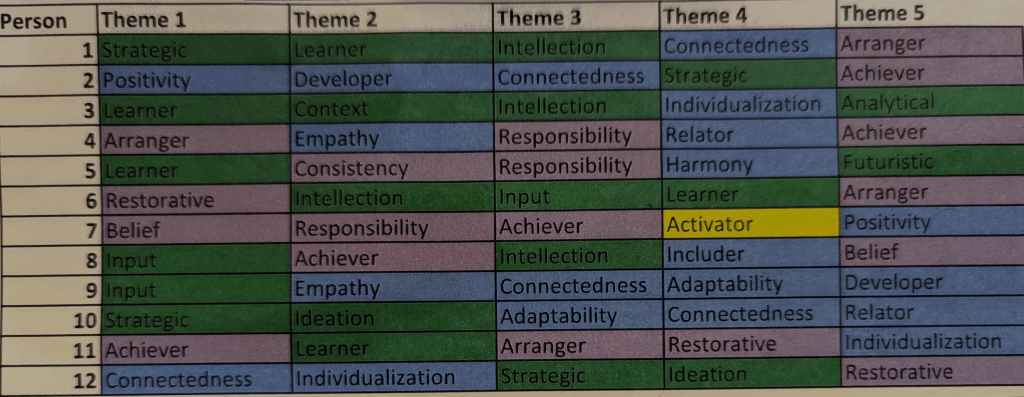
Facilitating team learning around team dynamics means growing – and showing – our abilities to be self-aware, other aware, empathetic, emotionally intelligent, and skilled at how to listen deeply, share wholeheartedly, journey forward together with common purpose and shared appreciation.
This stuff takes practice – but every team can grow. EVERY ONE.


Leave a Reply